
Buyers in pharma and banking rarely enquire on the strength of a two-line portfolio card. They want to see what was built, how it was delivered and what changed. We built an AI case study writer for ourselves to close that gap: a LangGraph pipeline that turns a short project brief into a full portfolio case study, checks every claim, blocks confidential client names in code and publishes nothing without a person approving it.
This is our own product, built and run by Ranbanka Systems on www.ranbanka.com. It is also a working example of the kind of controlled, auditable AI system we build for clients through our AI solutions work.
The challenge
Our portfolio listed each project in two lines. That was enough to show breadth, but not enough for the buyers we work with most, who read real case studies before they get in touch.
We had three constraints that pulled in different directions:
- Writing by hand is slow. Turning dozens of delivered projects into full write-ups competes with client work.
- Letting AI write freely is risky. A language model will happily fill gaps with plausible details: a timeline, a team size, a metric. On a portfolio page, an invented detail is worse than no detail.
- Many projects were delivered white-label through agencies. A detailed write-up must not reveal the end client or the agency, in the title, the URL, the sidebar or anywhere in the body.
So we needed speed, truth and confidentiality at the same time.
What we built
A case-study pipeline in LangGraph, where each step has one job and the risky ones are handled in plain code rather than left to the model's judgement.
One short brief as the only new source of facts
For each project, the owner answers a short brief of 6–7 questions, in English, Hindi or Hinglish. That brief, together with the site's verified company data, is the only material the writer may use. If the brief is silent on something, the page stays silent too.
Stop early when there is nothing to do
A check_existing step runs first. If the project already has a case study, the pipeline stops before any LLM call, so no money is spent on duplicate work.
Drafting, then parallel checks
The writer drafts the page from the brief and verified data only. The draft then goes through two kinds of checks in parallel:
- Fact checking. The same fact checker we use for our blog reviews every claim. For case studies, the brief counts as verified facts, along with the list of published pages that may be linked.
- Plain-code checks. SEO rules (700+ words, the target keyword, valid internal links) and a name-leak guard that fails any draft whose title, URL, summary, sidebar or body names a confidential brand, an agency, or any extra word listed in the brief.
Rewrites, then a human
If a check fails, the pipeline rewrites automatically, up to three drafts in total. After that, a person reviews the page. Even an approval cannot publish a draft that contains a leaked name; the guard runs again at that point.
Publishing
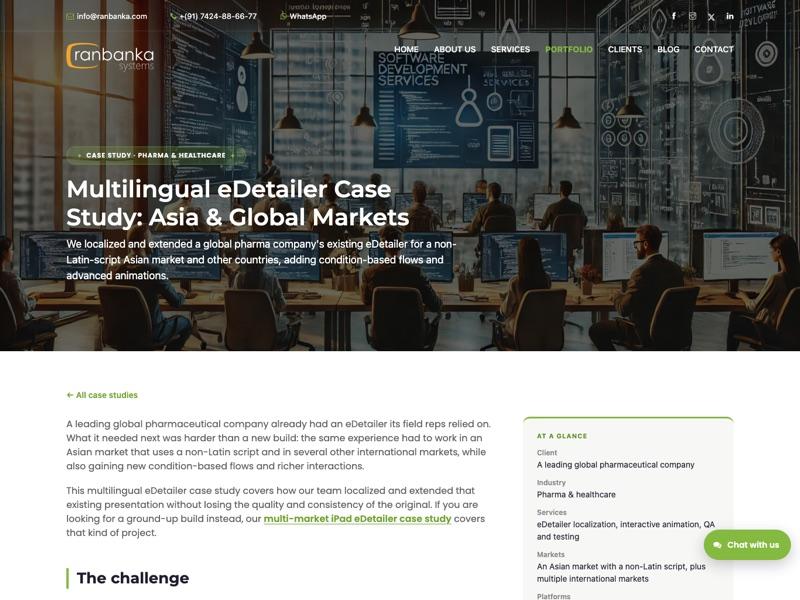
Published pages get an 'At a glance' sidebar, a social share image and a sitemap entry. Anonymous case studies show no project screenshot and are not linked from the named portfolio card, so nobody can connect the two. Examples of the output include our multilingual eDetailer case study and our bank website redesign case study.
Connected to our chat assistant
Our website chat assistant knows the published case studies and links them when they are relevant. When a reply names an agency client, the assistant leaves out any anonymous case-study link, so a named client and an anonymous write-up never appear side by side.
How we delivered it
The system was built in-house by the Ranbanka team on a deliberately simple stack:
- Claude Opus 5.5 for drafting and fact checking
- LangGraph with a SQLite checkpointer, so each run's state is saved and a draft can wait for human review without losing its place
- Python for the pipeline and the plain-code checks
- Next.js static pages with generated Open Graph images for the published case studies
The hardest problem was holding confidentiality and truth together. Fact checking with a model works well for catching unsupported claims, but a model's judgement is not enough when the risk is a leaked client name. One slip is one too many. So the name-leak guard is not an AI step at all: it is plain string matching in code, applied before human review and again at approval. The model can be wrong; the guard is not asked to guess.
The pipeline is covered by an offline test suite, so changes to prompts or checks can be verified without spending on live model calls.
This matters for clients who work with us white-label. If you are an agency evaluating partners, our guide to white label frontend development covers how we approach confidentiality more broadly.
The result
- 6 case studies published on ranbanka.com: 5 anonymous and 1 named.
- Every page reviewed and approved by a person before going live.
- About $0.10–0.40 of AI cost per page, depending on how many drafts it needs.
- Name-leak guard in code, checked before review and again at approval.
- Offline test suite covering the pipeline.
The bigger change is practical. A project owner can now answer a handful of questions in whichever language is comfortable, and a reviewed, fact-checked case study follows, without a writer starting from a blank page and without the risk of confidential names or invented results reaching the site.
The same pattern applies well beyond case studies: a narrow source of truth, AI where it adds speed, plain code where the stakes are absolute, and a human at the final gate. You can see more of what we build on our services page.
Want a controlled AI pipeline for your own content or data?
If you need AI that works from your verified data, respects confidentiality and keeps a person in the loop, we can help you scope it. Book a free initial consultation and we will respond within 24 hours.